Non Slip Wheelchair Transfer Pad Review
A non slip wheelchair transfer pad built for two-caregiver moves between bed, chair, and car. Here's where it helps and where it falls short.
As an Amazon Associate I earn from qualifying purchases. Some links on this site are affiliate links, if you buy though them I may make a commission at no extra cost to you.
Quick Verdict
Two sets of hands, four padded handles, and a non slip surface that actually grips. The Heavy Duty Wheelchair Transfer Pad solves the back-breaking part of caregiving, but only if you have a second person, because solo use isn’t safe here.
Buy if you:
- Have a second caregiver available for every transfer
- Move a loved one between bed, wheelchair, and car regularly
- Want to cut back strain during daily lifts
- Need something foldable that fits in a car trunk or bag
Skip if you:
- Are the only person doing transfers, solo use isn’t recommended
- Need to move someone over 220 lbs
- Want a rigid slide board for independent scoot transfers
| Weight capacity | Up to 220 lbs |
|---|---|
| Handles | 4 reinforced PU leather wrapped |
| Straps | 2 shoulder straps + dual safety straps (waist & thigh) |
| Material | Waterproof oxford fabric, non-slip surface |
| Caregivers required | Minimum 2 |
| Portability | Foldable, fits bag or car trunk |
The Back Injury Non-Slip Floors Can’t Prevent
Caregiver back injuries usually don’t come from one bad lift. They come from a hundred small ones. Moving someone from a bed to a wheelchair a few times a day, day after day, is where the damage adds up, and it’s exactly the situation the Heavy Duty Wheelchair Transfer Pad is built for. As occupational therapists, we’ve spent years watching family members improvise transfers with a bear hug and a prayer, and this is a far safer answer than that.
The pitch is simple. Instead of one person hauling all the weight, this pad puts a non slip surface under the person and gives two caregivers a set of handles to share the load. That’s the whole idea, and it’s a good one. The catch is right there in the name of that idea too: two caregivers. More on that later, because it matters more than the listing lets on.
What’s Built Into the Pad
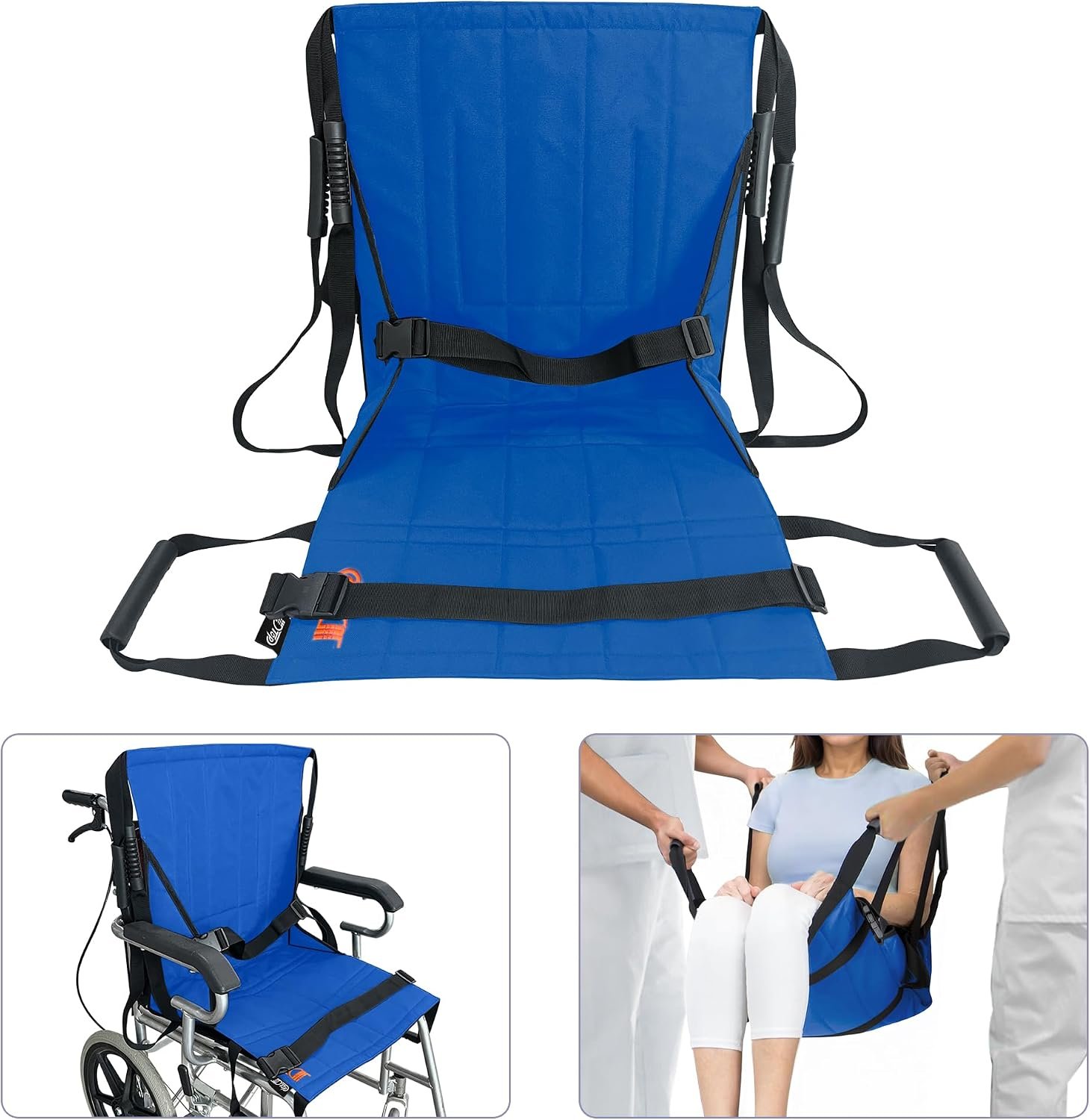
Four handles, two shoulder straps, and a 220 lb ceiling. That’s the shorthand version. The pad is made of waterproof oxford fabric with a high-friction non slip surface on the side that faces the person, so they don’t slide around mid-transfer. On the caregiver side you get 4 reinforced handles wrapped in PU leather, plus 2 load-bearing shoulder straps that spread the weight across your frame instead of dumping it all into your lower back.
There are also dual safety straps that secure across the waist and thighs. Those are the difference between a controlled move and a scary one, because they keep the person anchored to the pad instead of shifting when you lift. The whole thing folds down small enough to stash in a bag or trunk, which is a genuine plus if you’re doing car transfers or traveling to appointments.
The Non Slip Surface: Where It Stops Sliding
The danger in a transfer isn’t the lift itself, it’s the half-second when someone starts to shift while you’re suspended between two surfaces and neither caregiver can recover fast enough. The high-friction fabric grips the person in place during that window, and the dual waist-and-thigh straps back it up so there’s no relying on friction alone. Together they’re what separates a controlled move from a dropped one.
This is where the versatility shows up too. Bed to wheelchair, wheelchair to car, bed to shower, even stair-lift assistance, the same pad handles all of them. The waterproof oxford means a shower transfer won’t ruin it, and a wipe-down handles cleanup in seconds instead of tossing it in the wash. For anyone managing daily care in a home setting, the no-wash cleanup matters: wipe-down in seconds versus tossing fabric in a laundry cycle makes daily use stick.
The Two-Caregiver Rule Isn’t Optional
Here’s the part the marketing softens: you need two people, every single time. The listing lists it as a “note,” but from an OT standpoint it’s the whole ballgame. This pad has no rigid structure, so a single caregiver can’t safely control a person’s weight with it. Try to go solo and you lose the balance that makes it safe in the first place.
That’s a real limitation for the exact people who often need help most, the spouse caring alone, the adult child managing a parent by themselves. If that’s your situation, this isn’t your tool, and no amount of clever handles changes that. It’s worth being blunt about it before you buy, because a pad that requires a partner you don’t have is a pad that sits in the closet. Know your setup first.
Get it now
Heavy Duty Wheelchair Transfer Pad
Get the best price on Amazon →As an Amazon Associate I earn from qualifying purchases. Some links on this site are affiliate links, if you buy though them I may make a commission at no extra cost to you.
Who This Pad Actually Fits
The sweet spot is any setup where two people are already in the room for every transfer: a couple managing a parent together, siblings splitting shifts, home health aides who always work paired, or a nursing floor where two-person lifts are policy. If that describes your situation, the pad’s design clicks, four handles, two shoulder straps, load shared cleanly down the middle.
It also fits the traveling situation well. Post-surgery recovery, appointments across town, a weekend at a relative’s house, all of those involve car transfers where a foldable pad beats hauling rigid equipment around. If the person you’re helping weighs under 220 lbs and you’ve always got a second set of hands nearby, this lands squarely in your lane.
Transfer Pad vs. a Rigid Slide Board
These solve different problems, so don’t confuse them. A rigid slide board bridges two surfaces so a person can scoot across it, often with minimal or no help, which is great for someone with decent upper-body strength who mostly needs a bridge. This transfer pad is the opposite approach: it’s for someone who can’t do the scooting themselves and needs two people to move them entirely.
The deciding factor is one question: can the person push or scoot any of their own weight? If yes, even a little, a slide board puts that capacity to work and may let one caregiver manage alone. If no, the transfer pad is the right call, but only if you have a second person every single time. Get that wrong and neither piece of equipment saves you.
Tips Before Your First Transfer
Practice the choreography before you trust it with a real move. The first few transfers with any new equipment are always the clumsy ones, so run through the steps with your partner while the person is safely seated. Agree on who lifts on the count, and who leads.
Always fasten both safety straps across the waist and thighs, even for a short move. It feels like an extra step you can skip, and it’s exactly the step that keeps someone from sliding when the two of you aren’t perfectly synced. Use the shoulder straps rather than relying only on grip strength, since spreading the load is the entire point. And keep the non slip side toward the body, not the surface, so the person stays anchored to the pad while you move it.
Pros
- Non slip surface plus dual safety straps keep the person from sliding mid-transfer
- 4 padded handles and 2 shoulder straps spread the load across two caregivers
- Waterproof oxford fabric wipes clean, no laundering needed
- Folds compact enough for a bag or car trunk
- Works across bed, wheelchair, car, shower, and stair transfers
Cons
- Requires at least two caregivers, solo use isn’t safe
- 220 lb weight limit rules out heavier individuals
- No rigid structure, so it won’t help with independent scoot transfers
What we’d improve
Two changes that would widen who this pad can help:
- The 220 lb ceiling, A higher-capacity version would cover a much larger slice of the people who actually need transfer help.
- The two-caregiver requirement buried as a note, This deserves to be front and center on the listing, not a footnote, so solo caregivers don’t buy the wrong tool.
Frequently Asked Questions
Can one person use the transfer pad alone?
No, single-caregiver use is not recommended. The pad has no rigid frame, so it relies on two people sharing the weight through the handles and shoulder straps. Going solo removes the balance that makes it safe.
What’s the maximum weight it supports?
It’s rated for up to 220 lbs. If the person you’re moving is heavier than that, you’ll want a different solution, since exceeding the limit risks both the equipment and everyone involved.
Is it waterproof enough for shower transfers?
Yes, the oxford fabric has a waterproof surface, so bed-to-shower transfers won’t damage it. You wipe it clean afterward rather than washing it, which keeps upkeep quick.
How do I clean it?
Wipe the waterproof surface down and it’s done in seconds. There’s no messy laundering, and the material is designed not to absorb odor, which matters for daily home use.
Will it fit in a car for appointments?
Yes, it folds compact enough to stash in a bag or car trunk. That portability is one of its stronger points for families doing transfers away from home.
Is this the same as a slide board?
No. A slide board is rigid and lets a stronger person scoot across two surfaces, often on their own. This pad is soft and requires two caregivers to lift a largely dependent person. They serve different ability levels.
Can it help with getting someone up and down stairs?
It’s listed for stair-lift assistance, but stairs are the highest-risk transfer of all. Only attempt it with two confident caregivers, the safety straps fastened, and a clear plan for each step.
Does it come with any warranty or support?
Warranty terms vary by seller, so check the current listing details before buying. For any coverage or replacement questions, going through the Amazon product page is your cleanest route.
Clicking takes you to the seller's website. We may earn a small commission if you purchase, at no extra cost to you.
Get it now
Heavy Duty Wheelchair Transfer Pad
Get the best price on Amazon →As an Amazon Associate I earn from qualifying purchases. Some links on this site are affiliate links, if you buy though them I may make a commission at no extra cost to you.